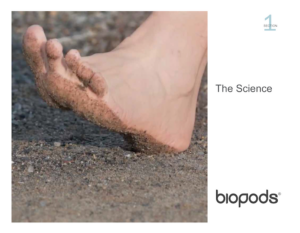
 Lesson 1: The Science
The laws of physiology and why foot function must be understood as adaptive, not fixed.
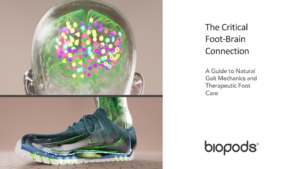
Learn about latest advancements in gait-related neuromuscular mechanics and the new therapeutic paradigm for foot-related pathologies.
Roy Gardiner, Sam Dubé, MD; PhD, Scott Bautch, D.C., DACBOH, CCST, CCSP; Bruce Comstock, DC; Tim Wakefield, DC, DC, DACBSP, CPCO, CCST, CSCS; Birger Baastrup, DC
The Critical Connection was developed to serve as a selfstudy online course for healthcare, rehabilitation, and sports training professionals. Developed in collaboration with leading experts and practitioners in the field, it will provide valuable background information about the scientific principles that led to the development of Biopods® and Bareoot Science® technologies and a new paradigm for assessing and treating most foot-related pathologies.
Biopods / Barefoot Science technologies are the result of more than 40 years of research in foot function and related pathologies, which has encompassed a comprehensive review of relevant global studies and a thorough analysis of current healthcare protocols and treatment methods.
Over the years, the Biopods research and development team has reviewed the effects of immobilization on long-term health and wellness, as well as the effects of environmental influences on foot function. One of the many outcomes of these efforts is a more accurate method for measuring the three-dimensional neuromusculoskeletal dynamics of the foot structure during full weight-bearing states in static and dynamic environments.
The course is designed as a self-paced experience that can fit into the schedule of every busy healthcare professional.
Each of the four lessons includes an online component with a video presentation by expert instructors and accompanying slides that you can access any time — and a course book and a scientific monograph for in-depth study following each lesson.
The course framework is built around the same core scientific model: the foot is a sensory, muscular, skeletal, vascular, fascial, and neurological system that adapts to the information and demands it repeatedly receives.
Lesson 1: The ScienceThe laws of physiology and why foot function must be understood as adaptive, not fixed.
 Lesson 2: Optimal Foot and Lower Limb Function
Optimal foot mechanics, gait preparation, and the role of the Windlass Mechanism, sesamoids, and cuboid pulley system.
 Lesson 3: Gait-related Pathologies
Pathology patterns, attenuated sensory input, and the conventional baseline problem in foot assessment.
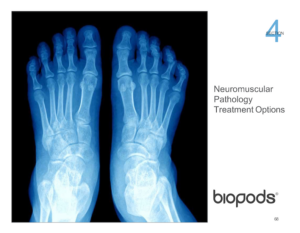 Lesson 4: Neuromuscular Pathology Treatment Options
Clinical protocols, stimulated alignment control, progression, contraindications, and practical application.